Request a proof from someone who has no account.
It comes back to you sealed. Your own tool decides, with nobody squinting at a photo. Sandbox: 30 days, 100 proofs, no card.
Request a proof from a third party →Capture proof · Photos and videos
Captured live, sealed on receipt, tied to the device by its attestation. Whoever receives it verifies it from a link, with no account.
The demonstration proof, as seen by whoever receives a link: adjuster, case handler, judge. How to read it
It comes back to you sealed. Your own tool decides, with nobody squinting at a photo. Sandbox: 30 days, 100 proofs, no card.
Request a proof from a third party →Share a link anyone can verify. A job site, a flat inventory, a delivery: the same proof organisations get, one at a time. 3 free proofs every month.

 Scan to install.
The situations where the image comes from somewhere else, and you still have to decide.
The move, not the technique. What happens in between is described on the page that explains a proof.
Never from the gallery. The viewfinder guides you: level, UTC time, position lock.
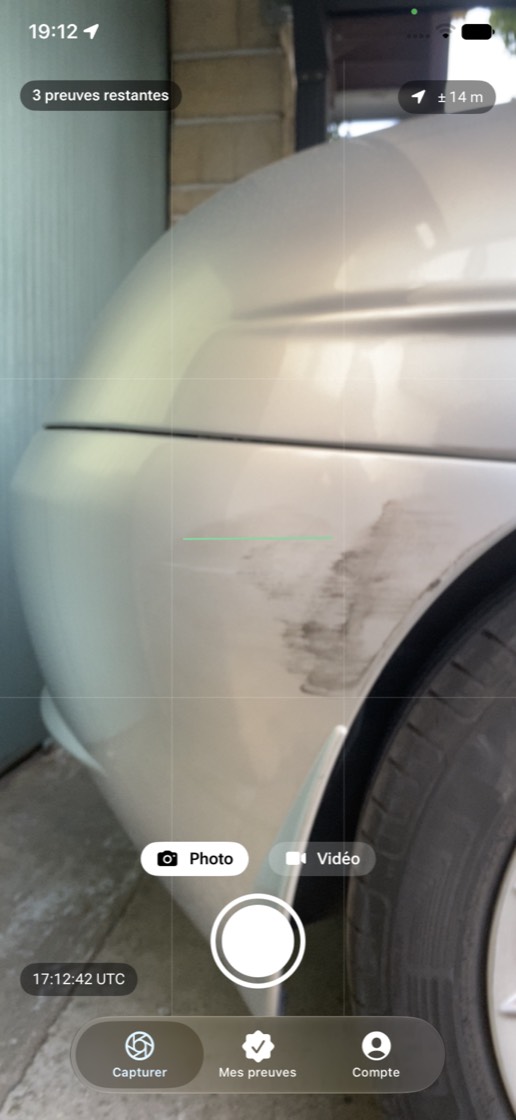
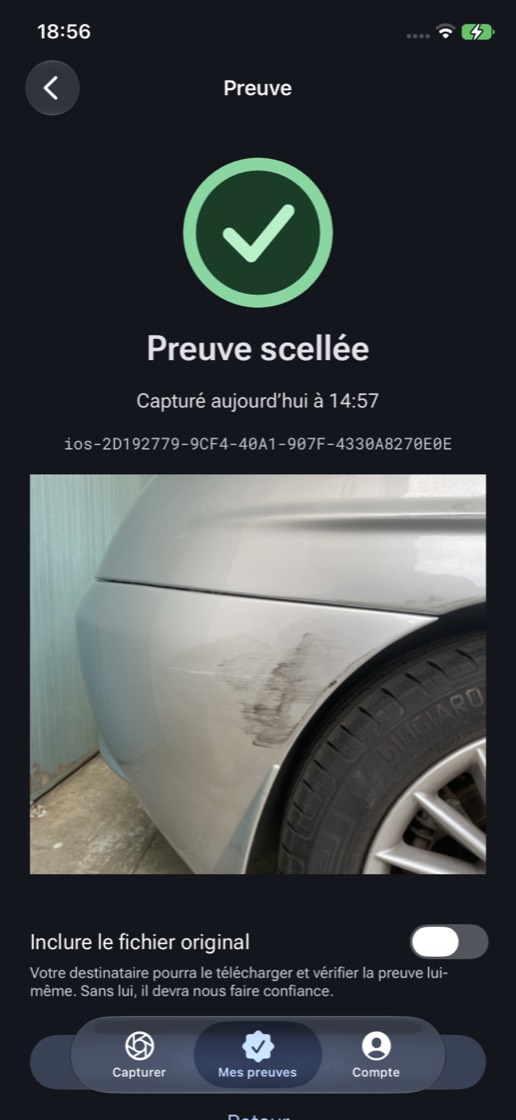
Nothing moves after that. You choose whether the link also gives the original file.
Whoever receives the link opens the verification page. No account, nothing to install.
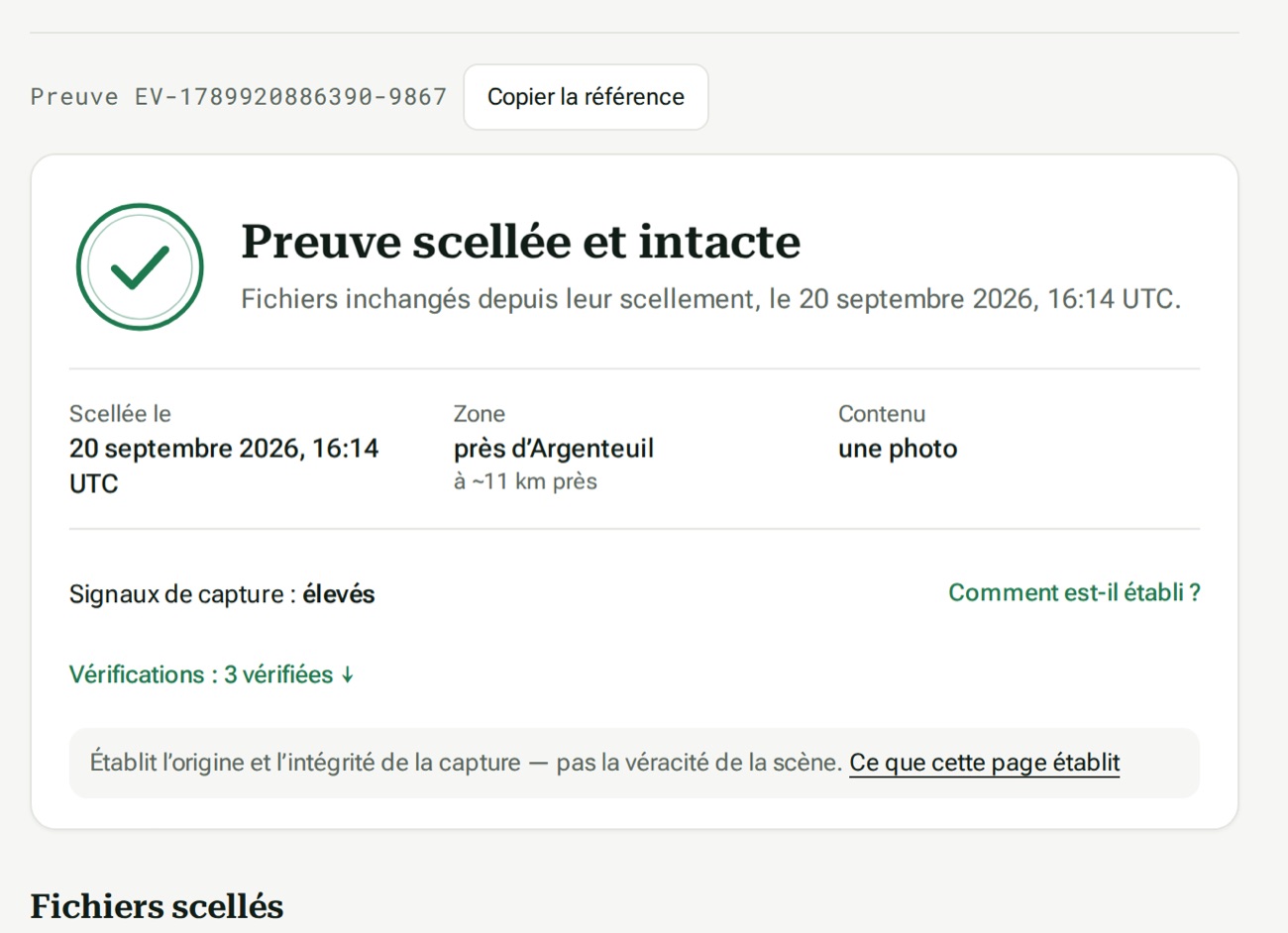
Every check says what it measured. Or that it could not. A missing check is named, with its reason, never hidden.
VerifiedFailedNot measured, with its reasonIn progress while the Bitcoin confirmation completes
In addition, an analysis looks for a screen re-capture or a paper print. It flags, it does not count: it says what it noticed, or that it could not conclude on that device.
A proof posted through the API, with no attested device, shows it: the page displays “Not measured” for the device. One channel does not lend its trust to another.
Read a proof block by block, on the demonstration proof.
It is written on every verification page, under the verdict: the page establishes the origin and integrity of the capture, not the truth of the scene. We would rather have a proof that states its limits than a promise no proof can keep.
The photo or video does not always come from you. It comes from your field engineer, your policyholder, or your own application. All three paths produce the same proof, verified the same way.
Live capture, never from the gallery. With no network, the proof waits for a connection and goes on its own, with no duplicate.
In detail →You send a link. The recipient installs the app (iPhone or Android), captures on site, and the proof comes back to you.
The full flow →Post a proof from your back office, receive the decision through a signed webhook. With no device attestation, and the verification page says so.
For developers →What remains without us
Your proofs would survive. Every file carries its verification items, readable with public tools, without us.
No. In France a commissaire de justice is a public officer: their report carries weight because of who they are, not because of their technique. Evidiq establishes something else, and with no appointment: that this file existed at the latest on that date, that it comes from the app on an attested device, and that it has not changed since. Many situations do not warrant a bailiff but deserve better than a bare photo; that is where Evidiq serves.
That judgement always belongs to whoever receives the proof: adjuster, case handler or judge. What Evidiq adds is what an ordinary photo lacks: a date, an area, an attested app, and the demonstration that the file has not changed since it was sealed. File integrity and the date can be re-checked by the other side, with tools that are not ours.
Capture happens inside the app, never by import: to cheat, you have to film a screen. Measurements look for that re-capture, and the verification page says what they found, or that not all of them could run on that device. These measurements earn no points: they flag, they do not decide. What decides is the origin: where the file comes from, and the fact that it has not changed since.
The capture happens anyway. It waits for a connection, then goes on its own: depending on the device, it may need the app reopened. An interrupted capture never creates two proofs nor two charges.
Other questions are answered where they come up: what the person capturing for you sees, how we know the photo really comes from that phone, what happens to your data.
An organisation opens the sandbox, with no card. An individual installs the app, with three free proofs every month.
Hosted in France Encrypted at rest Non-extractable signing key, held in a KMS Candidate to the C2PA conformance program No cookies, no third-party trackers What proves it