Business

Request a proof from someone who has no account.

Your policyholder, your tenant, your courier: you send a link, the photo or video comes back sealed, dated, located and tied to the device. Your own tool decides, with nobody squinting at a photo.

30 days, 100 test proofs. No card. The sandbox gives you the API; link requests and webhooks open in a pilot, with pricing settled against your volume and your trade.

€947 MDetected fraud · France · 2025

Detected insurance fraud jumped 5% in 2025, and ALFA, the French insurance anti-fraud agency, now lists “photos altered with artificial intelligence” among the growing vectors. Detecting after the fact is no longer enough: proof has to start at capture.

Source: ALFA 2025 report, in L’Argus de l’assurance (French)

Three ways to capture, one proof

The photo does not always come from you. It comes from your field engineer, your policyholder, or your own application. All three paths produce the same proof, verified the same way. And for each, what the proof establishes: one channel does not lend its trust to another.

Your teams

The field app

Live capture inside the app, never a gallery import. Guided viewfinder: level, UTC time, position lock. On submission the app asks the device for an attestation; the verification page states whether it was obtained, and at what level.

With no network, the proof is built on the device and leaves as soon as the connection returns. Resumes with no duplicate.

Establishes: device, files, date, area.

Your customers, no account

The capture link

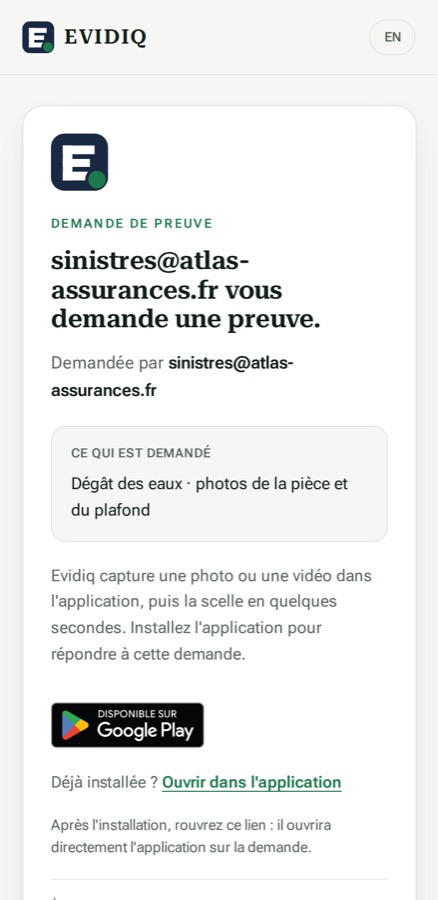
You create a request from the dashboard, with its instruction and the expected place. The recipient gets a link, installs the Evidiq app (iPhone or Android), captures on site, and the proof comes back to you. No account to create.

The link expires, and is revocable at any time. The recipient watches their proof leave, never your verdict.

Establishes: the same as the app, since the app does the capturing.

Your own systems

The API

Post a proof from your back office, receive the decision through a signed webhook. Idempotency key, remaining call budget in the headers, integration guide.

A proof posted through the API does not borrow the trust of an attested capture: the verification page states that no device attestation exists for it.

Establishes: the file fingerprints, sealed and anchored, and the date of receipt. Neither device nor content signature: the page shows “Not measured”.
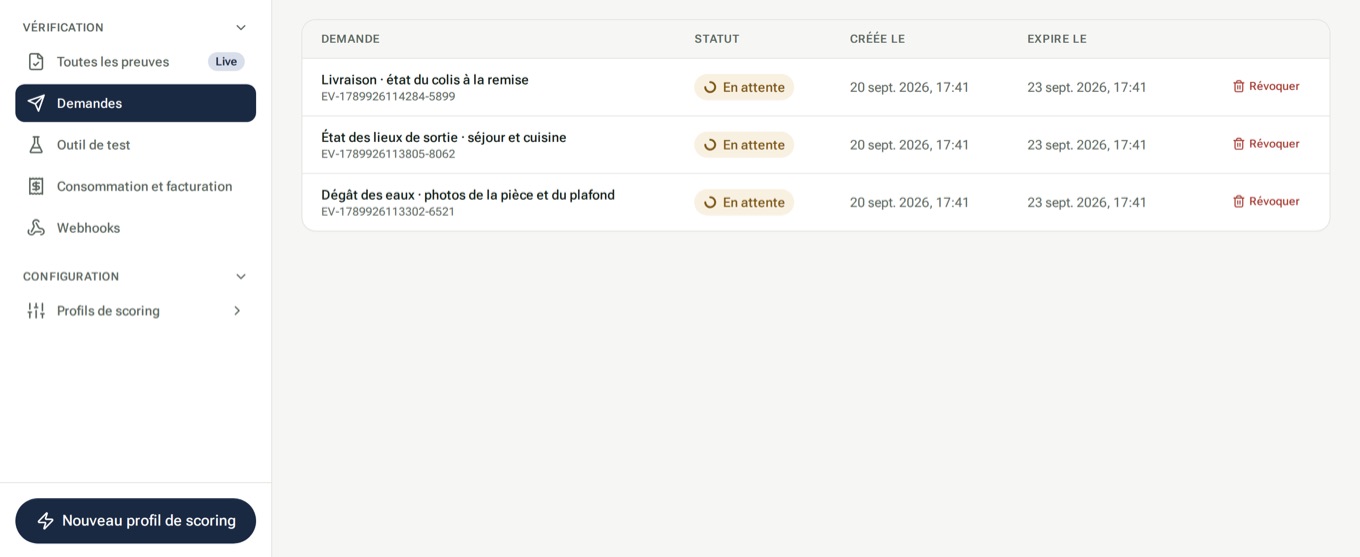
The console

A dashboard to request, follow and decide. With nothing to install: an API key is enough.

Proof requests

Instruction, expected place, recipient; title, reference and tags to find them again. The link, the QR code and the invitation e-mail leave from here, and are revoked from here. Where each request stands is read on the proof.

Every proof in detail

Verdict, checks, photos and videos, chain of custody. The captured place and whether it matches the place you had requested.

Escalations and reviews

Two queues for the cases that were not accepted outright, and a CSV export of the proof list.

Webhooks under watch

Deliveries, failures, latency, and a button to replay what did not get through. We refuse to send an unsigned webhook.

Usage and billing

Billable volume for the current month or the last thirty days, with its export.

The verdict has no button

No “approve” or “reject” in Evidiq’s place. You mark a case as handled; you do not rewrite what the proof says. That is the difference between “trust us” and a proof.

Your own rubric, on the business plans

Starting point: Evidiq’s standard rubric. You set the weight of each signal and, within the bounds shown in the dashboard, the threshold above which a case is accepted with no review.

A second rubric for what is not attested

A proof with no confirmed device attestation, posted through the API for instance, is scored on a separate, read-only rubric chosen by its proof level. It never borrows the score of an attested capture.

No threshold figure on this site: a published threshold is a target for a fraudster, and a value that will change. The real bounds are in your dashboard.

Where a photo has to hold up

The situations where the image comes from somewhere else, and you still have to decide.

Insurance and loss adjusting

Remote adjusting rests on photos sent by the policyholder. A capture link brings you a photo taken inside the app, dated, with the area recorded at the shutter, and any inconsistency of place or date flagged.

The policyholder captures from a link. The simple case goes straight through.

In detail →

Construction sites

Progress, snags, handover, statutory notices. A dated and located photo beats an end-of-project argument, when putting the work right costs weeks.

The snag is dated, located, tied to the device. The dispute stops at the photo.

In detail →

Property inventories

Check-in, check-out, deposit. The photo record arrives dated, located and verifiable: tenant and landlord open the same page, and read the same thing on it.

The check-in inventory is sealed on the day of check-in, not contested on the day of check-out.

In detail →

Delivery and logistics

“The parcel arrived broken”, “it never arrived”. Proof of delivery becomes an exhibit, not one word against another.

The parcel at delivery, with a time and a place nobody rewrites.

In detail →

What your third parties will ask

What does the person capturing for me see?

Before the camera opens, they see what their data is used for and who receives it. They see your instruction, capture, and watch their proof leave. They never see your verdict. They have no account to create, and you revoke the link from your dashboard.

Who can capture a proof?

Three channels, one proof: your teams with the app, a third party with no account to whom you send a capture link, or your own systems through the API. The recipient of a link has no account to create: they install the Evidiq app (iPhone or Android), open the link, capture, and the proof comes back to your dashboard.

The questions everyone asks, bailiff, court, screen, no network, are on the home page. What happens to the data: on the security page.

Start with one proof request.

The sandbox is open to all: 30 days, 100 test proofs through the API, no card. Link requests, webhooks and pricing are settled in a pilot, against your volume and your trade: we would rather hold a price list to real numbers than post one at random.

Hosted in France Encrypted at rest Export and erasure at any time No cookies, no third-party trackers What proves it