You received an Evidiq link
Here is what you are looking at.
A verification page, block by block, on the demonstration proof. Open it alongside: everything below can be read on it, with no account and nothing to install.
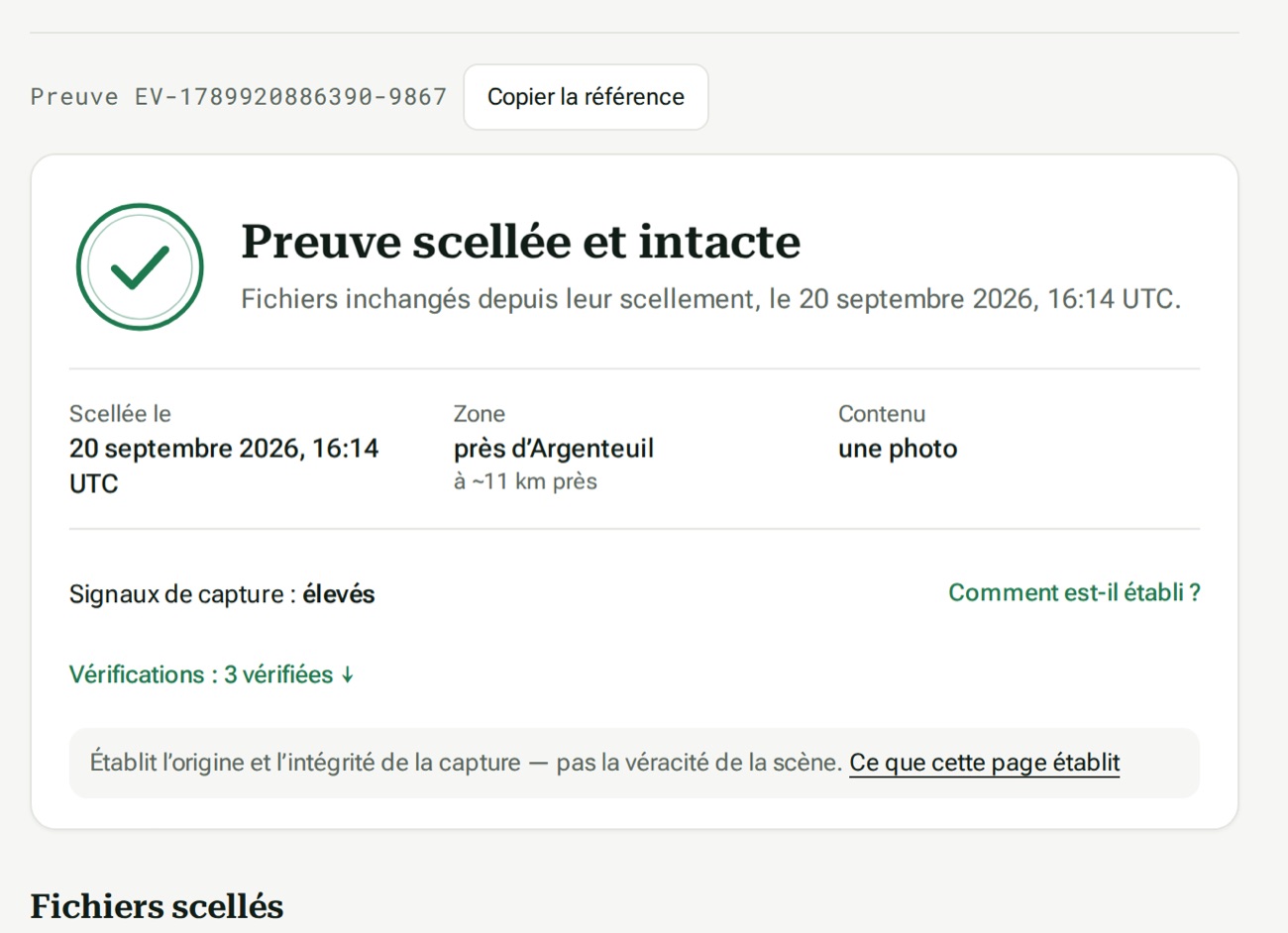
1 · The verdict
“Proof sealed and intact” means one precise thing: the files have not changed since they were sealed, on the date shown below it. The verdict does not say the scene is true. It is written under the card, on every page: the page establishes the origin and integrity of the capture, not the truth of the scene.
When a file has changed, or a decisive check has failed, the verdict says so just as plainly. Only an established contradiction accuses; a check that could not run accuses nobody.
2 · The three facts
- Sealed on: the date and time, in UTC, at which we sealed the proof. It is the latest date at which the file existed.
- Area: the position recorded at the shutter, rounded to an area. A fact, not a check: the page gives a precision, not an address.
- Content: a photo, a video, or both.
3 · The checks, and their three states
Every check is in one of three states: Verified, Failed, or Not measured with its reason. No figure per check, ever: one point more or less tells nothing to whoever has to decide. A fourth state, In progress, appears only while the Bitcoin confirmation completes.
Device and app
On submission the app asks the device for an attestation: on Android, the Play Integrity attestation; on iPhone, App Attest. The page states whether it was obtained, and at what level. A proof posted through the API, with no device, is marked Not measured here: one channel does not lend its trust to another.
File integrity
The file fingerprints were sealed, and the page compares today’s files against those fingerprints. For a capture whose attestation is confirmed, a C2PA manifest, the open provenance standard, is signed and attached.
Sealing date
An independent timestamp, anchored in Bitcoin through OpenTimestamps. It can be re-verified with public tooling or your own node, without us.
Requested place
This check only appears when the organisation that requested the proof had stated an expected place. The page then says whether the captured place matches.
4 · Capture signals
Alongside the checks, measurements look for a screen re-capture or a paper print. They have their own vocabulary, never the three states: signal detected, nothing noticed, partial analysis, inconclusive. They flag, they do not count: none of them makes or unmakes a verdict. What decides is the origin.
5 · What the page establishes, and what it does not
- Establishes: the latest date, the area, the attested device and app, the files intact since sealing, and, when the device has been enrolled, its sensor, as a bonus.
- Does not establish: that the scene is genuine in itself, nor what the proof is worth in your dispute. That judgement is yours.
6 · Verify without taking our word
Every proof carries its items, readable with public tools.
- The self-contained PDF file: the verdict, the items and the method to re-check everything, in one file to archive. Issued the first time a shared link is opened.
- The Bitcoin anchor: an OpenTimestamps file, re-verifiable with public tooling or your own Bitcoin node.
- The C2PA manifest, for attested captures: readable with any C2PA tool. The signer shows as “not listed” there until our admission to the conformance program is granted; where we stand.
If the original file is attached to the link, you can recompute its fingerprint yourself. If it is not, the author chose not to publish it: you will then have to take our word for what the photo shows, not for its integrity.
Two questions that keep coming
How do you know the photo really comes from that phone?
On submission the app asks the device for an attestation, and the page states whether it was obtained, and at what level. When the device has also been enrolled, the physical signature of its sensor, readable in raw images, is compared with the capture’s. That second check only counts as a bonus: a proof never rests on it alone.
Do you need an account to verify a proof?
No. The verification link opens in any browser, with no account and nothing to install. The page names what was verified, check by check, and says what could not be.
Bailiff, court, screen, no network: the straight questions, on the home page.
You have read a proof. You can make some.
An organisation opens the sandbox, with no card. An individual installs the app, with three free proofs every month.